
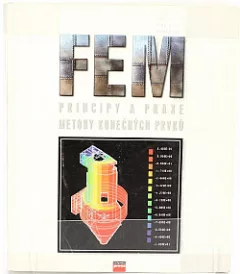

The Multiple reciprocity boundary element method
The boundary element method (BEM) is a numerical technique which is now emerging as a viable alternative to finite difference and finite element methods for solving a wide range of engineering problems. The main advantage of the BEM over domain-type methods is its unique ability to confine the dependence of the problem solution to the boundary values only.
This reduces the data preparation effort and saves computer time since the system of equations to be solved is smaller than those resulting from domain techniques. However, the main drawback of the BEM occurs in problems such as those with body forces, time-dependent effects or non-linearities. In these cases, the domain integrals that appear in the integral equation are usually evaluated by using cell integration.
Although this technique is effective and general, it affects the overall efficiency of the BEM and detracts from its elegance due to the additional internal discretization.
In an effort to avoid the internal discretization, many different approaches have been developed. The most recent one is the multiple reciprocity method (MRM) which is the main subject of this book. The basic idea behind the MRM is to employ a sequence of higher order fundamental solutions which permit the application of the reciprocity theorem recurrently.
The success of the method is reflected in the works carried out by several active groups around the world and presented here in the chapters of the book.
This reduces the data preparation effort and saves computer time since the system of equations to be solved is smaller than those resulting from domain techniques. However, the main drawback of the BEM occurs in problems such as those with body forces, time-dependent effects or non-linearities. In these cases, the domain integrals that appear in the integral equation are usually evaluated by using cell integration.
Although this technique is effective and general, it affects the overall efficiency of the BEM and detracts from its elegance due to the additional internal discretization.
In an effort to avoid the internal discretization, many different approaches have been developed. The most recent one is the multiple reciprocity method (MRM) which is the main subject of this book. The basic idea behind the MRM is to employ a sequence of higher order fundamental solutions which permit the application of the reciprocity theorem recurrently.
The success of the method is reflected in the works carried out by several active groups around the world and presented here in the chapters of the book.
Komentáře
Přihlas se, abys mohl/a přidat komentář.


Zatím žádné komentáře. Buď první!